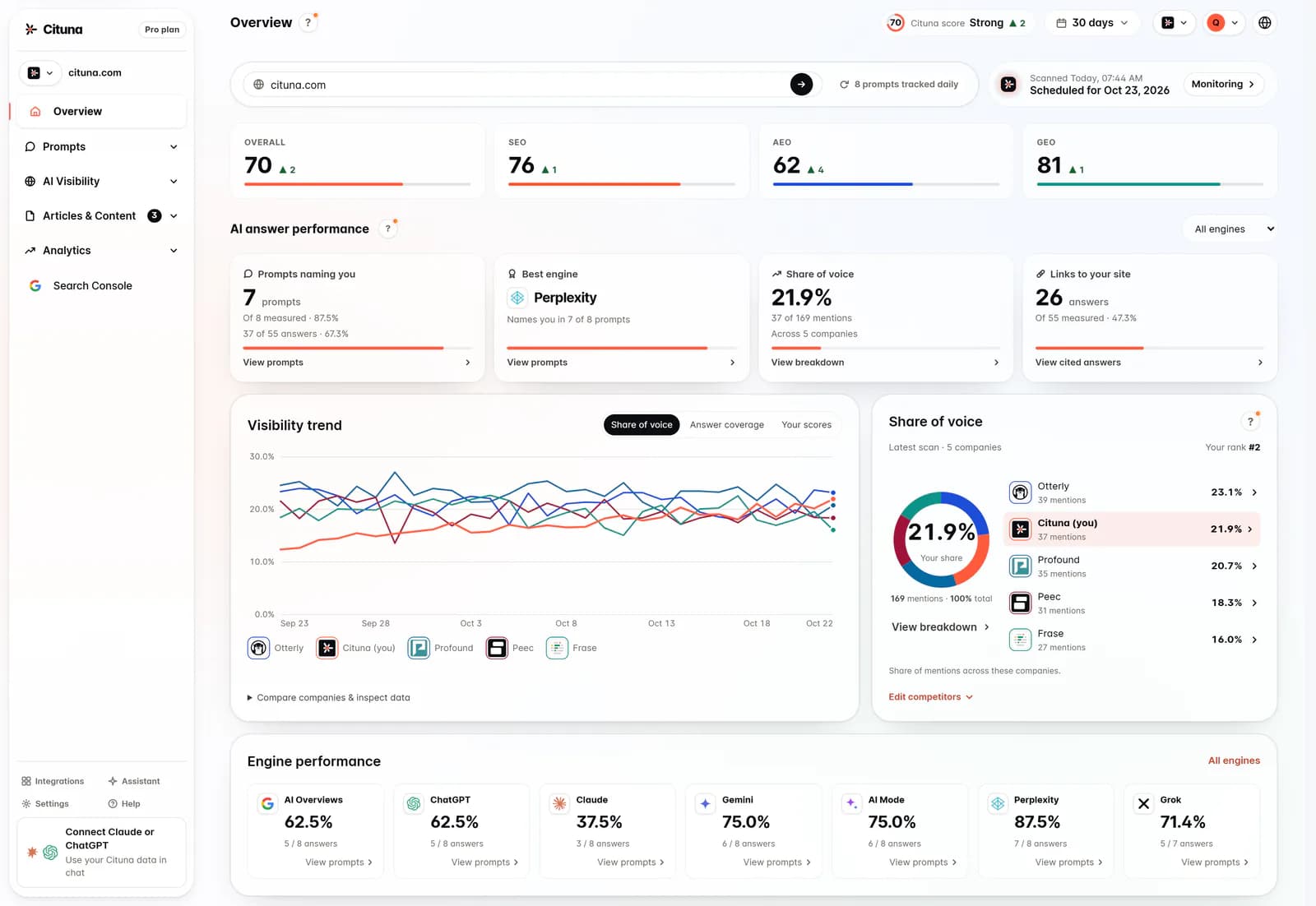
The crawler question for Claude is ClaudeBot (training) and Claude-User (user-initiated fetches). Blocking is a real option with a real cost, and the two directions are not symmetric. Claude answers from model weights unless web search is enabled for the conversation. Cituna shows the real cost of blocking by checking daily which brands Claude recommends and how often you are among them.
How Claude actually decides
In Claude’s default mode there is no live retrieval at all, so what Claude says about your brand reflects what was in its training data, which is why the fix for Claude is slower and more structural than on the live-retrieval engines.
Its citations skew toward well-established, text-dense sources that were prominent at training time. In practice that means the surfaces worth auditing first are documentation sites, long-form editorial, Wikipedia, technical references.
The method, in order
Know which agent does what: ClaudeBot (training) and Claude-User (user-initiated fetches). Training access and answer-time retrieval are usually separate controls, and blocking the wrong one achieves the opposite of what was intended.
Decide what you are protecting. Blocking reduces the chance of being quoted without attribution; it also reduces the chance of being recommended at all. For the other reasons an engine passes you over, see why Claude doesn’t recommend your brand.
Consider the asymmetry. Being absent from Claude is easy to cause and slow to undo, especially here, where the index does not refresh quickly. To win the citations back, see how to get cited by Claude.
If you do block, block deliberately and document it, so a future traffic investigation does not spend a week rediscovering it.
Re-check after any robots.txt change that the agent you meant to allow is still allowed.
The honest caveat
A brand founded or renamed recently can be absent from Claude entirely while doing well everywhere else, and no amount of on-page work fixes that quickly. It is the clearest example of why a single-engine tool misleads.
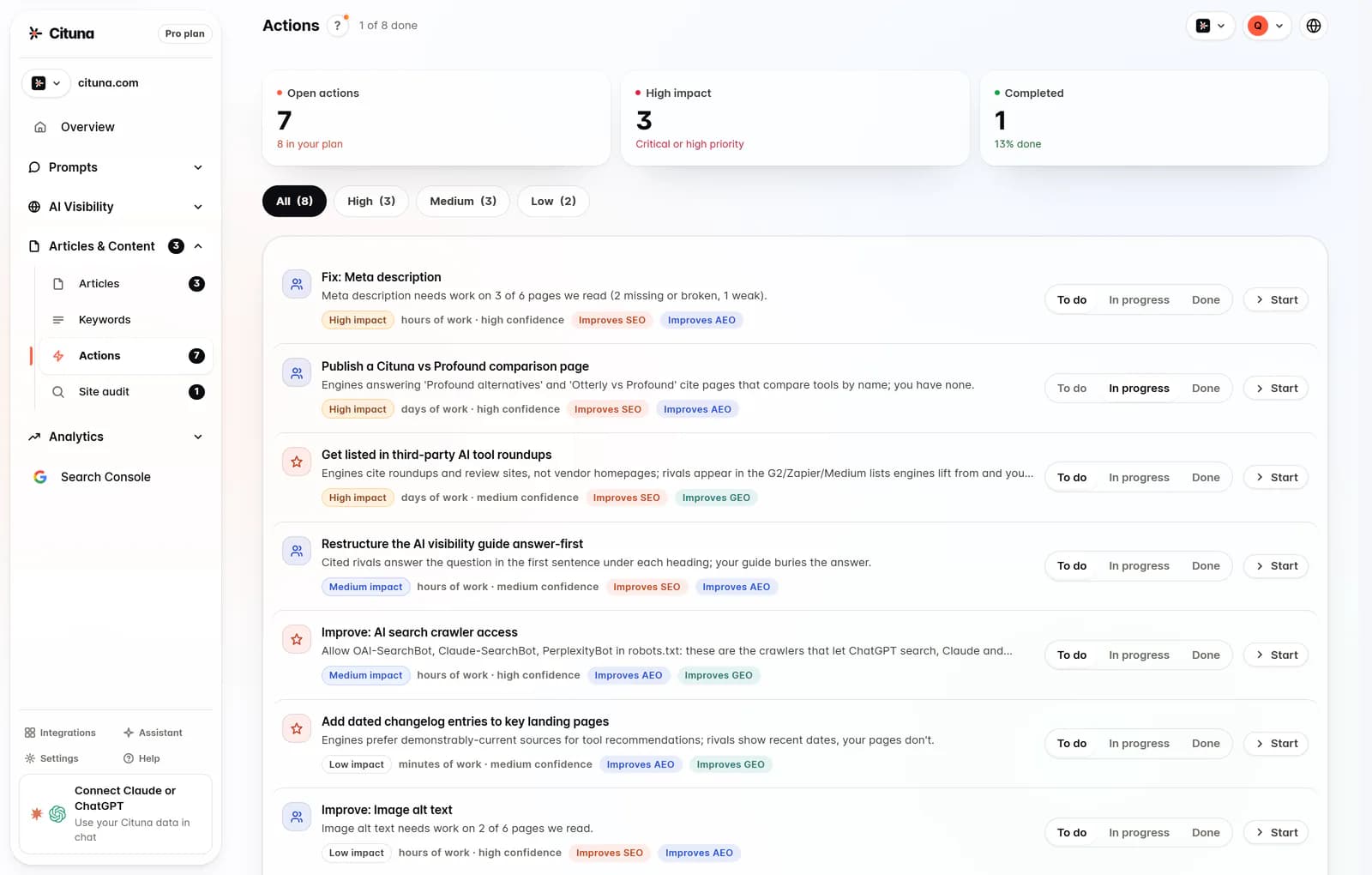
Cituna checks Claude daily alongside Google AI Overviews, ChatGPT, Gemini, Google AI Mode, Perplexity and Grok, on the $49 Starter, and pairs the result with Google Search Console so a change here can be tied to real clicks. Then it does the work: it generates the fix for each gap, its AutoSEO writes and publishes the articles that answer the questions you are missing, and Claude or any other AI agent can work through the results over MCP.
Drafted with AI assistance from our own research and Search Console data, and reviewed by Rahul A before publishing. Rules and prices change; check the linked official source before you act.